
Introduction
With demand for Mimosa Hostilis Root Bark (MHRB) growing steadily among researchers, natural dye artists, soap makers, and botanical enthusiasts, the market has inevitably attracted inconsistent products and unreliable suppliers. Knowing how to identify quality mimosa hostilis root bark before you buy — or when your order arrives — can save you money, frustration, and wasted effort. The difference between premium MHRB and a substandard batch is visible, tangible, and in some cases even detectable by smell. In this complete buyer’s guide, we walk through every quality indicator you need to know: from color and texture to smell, origin documentation, and supplier transparency. Whether you’re buying for the first time or looking to upgrade your current source, this guide gives you the tools to evaluate MHRB with confidence.
What Makes MHRB Quality Vary?
Not all Mimosa Hostilis Root Bark is equal. Quality varies widely depending on several factors that occur before the product ever reaches you:
- Harvest region and growing conditions — soil type, altitude, rainfall, and climate all affect the concentration of tannins, pigments, and other natural compounds in the bark
- Which part of the plant was used — inner root bark is the most potent and valuable part; outer root bark or trunk bark are significantly different in composition and value
- Age of the material at harvest — bark harvested from mature trees typically has a higher compound concentration than bark from young or immature specimens
- Post-harvest drying method — bark dried too quickly, at too high a temperature, or exposed to direct sunlight can lose volatile compounds and degrade in color
- Storage conditions between harvest and sale — moisture exposure, poor packaging, and temperature fluctuations degrade MHRB significantly before it reaches the customer
- Processing method — excessive milling heat during powder production can degrade the bark’s phytochemical profile
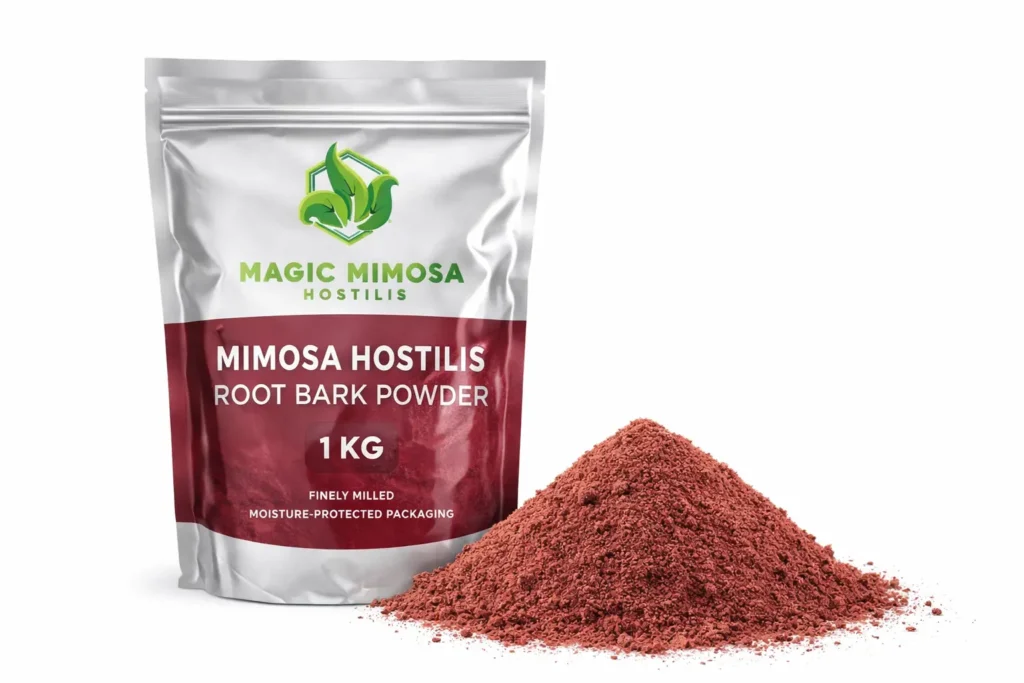
Browse more collection of our available Mimosa magic powder and products:
1. Color — The First and Most Reliable Indicator
Color is the single most useful quality indicator for MHRB, particularly for whole and shredded material where the natural bark structure is visible.
Whole and shredded bark — what good color looks like:
- The inner surface (the cut face of the bark) should be a rich, deep reddish-purple to burgundy color
- High-quality Mexican MHRB (Tepezcohuite) typically shows the darkest, deepest purple — often bordering on violet-brown
- High-quality Brazilian MHRB (Jurema Preta) typically shows a strong reddish-brown to medium purple
- The outer surface may be greyish-brown — this is normal and not a negative quality indicator
Powder — what good color looks like:
- Should be a consistent reddish-brown to deep purple-brown color throughout
- When mixed with water, good powder will immediately begin releasing a rich, dark reddish-brown color
- Color should be uniform — no pale patches, white streaks, or grey areas
Color red flags to watch for:
- Pale, washed-out, or predominantly grey color in the interior of whole or shredded bark
- Powder that appears uniformly tan, beige, or light brown with no reddish-purple tones
- Black or very dark spots suggesting mold or fungal contamination
- Extremely bright or artificially uniform color that doesn’t look natural
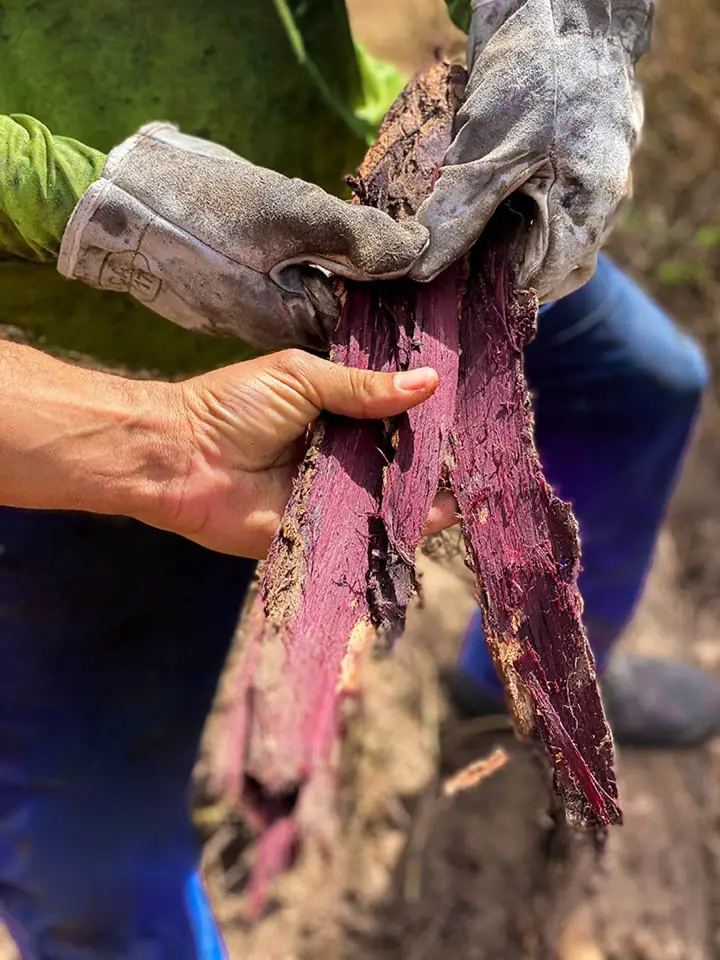
2. Texture — What Good Bark Feels Like
Whole and shredded bark:
- Should feel firm and fibrous — not brittle, not soft, not crumbling
- Good bark has a layered, fibrous structure that holds together without falling apart when handled
- Mexican MHRB will often feel slightly sticky or resinous due to its higher fat and resin content — this is a positive sign
- Brazilian MHRB will feel drier and less resinous, but still firm and fibrous
- Bark should not feel damp or soft — this signals moisture exposure and possible microbial growth
Powder:
- Should be a consistently fine, uniform texture with no lumps under normal storage conditions
- If the powder has clumped significantly, it has been exposed to moisture
- Should not feel gritty, sandy, or coarse — excessive grit may indicate contamination or adulteration with fillers
Texture red flags:
- Bark that crumbles to dust when handled lightly (over-aged or improperly dried)
- Bark that feels wet, slimy, or soft (moisture damage)
- Powder with hard lumps throughout (moisture exposure)
- Bark with a spongy or corky texture (may indicate trunk bark rather than root bark)
3. Smell — The Underrated Quality Test
What good MHRB smells like:
- Fresh, high-quality MHRB has a distinctive earthy, woody, slightly tannic aroma
- There is often a subtle astringent note — similar to strong tea or raw timber
- Some batches carry a faintly sweet or herbaceous undertone
- The smell should be noticeable but not overwhelming — a calm, botanical earthiness
Smell red flags:
- Musty or mildew smell — indicates moisture damage or mold; do not use
- Sour or fermented smell — indicates microbial contamination; do not use
- No smell at all — may indicate very old material or bark that has lost its volatile compounds
- Chemical or synthetic smell — a sign of adulteration or contamination
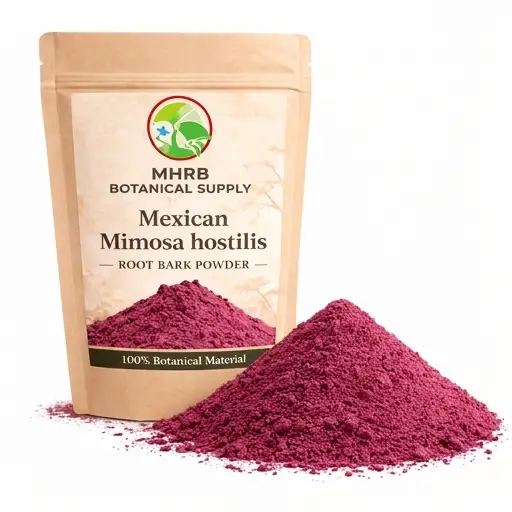
4. Origin Documentation — Know Where It Came From
Any reputable MHRB supplier should be able to tell you exactly where their product originates. Origin documentation directly correlates with quality and authenticity.
What to look for:
- Country of origin — is it Mexican (Chiapas or Oaxaca) or Brazilian (Bahia, Pernambuco, or other northeastern states)?
- Which part of the plant — the listing should clearly state “inner root bark” not just “bark” or “root”
- Batch or lot number — allows traceability and stock rotation
- Harvest date or approximate year — fresher batches are always preferable
- Third-party testing — a COA (Certificate of Analysis) from a third-party laboratory confirms purity and origin
To understand how origin affects quality and color, read our full guide: 👉 [Mexican vs Brazilian Mimosa Hostilis: What’s the Difference?]
5. Supplier Transparency — The Most Important Factor
The single strongest predictor of MHRB quality is the transparency of the supplier you buy from.
Signs of a reputable MHRB supplier:
- Lists country of origin clearly on every product page
- States which part of the plant was used (inner root bark)
- Provides batch numbers or lot codes
- Has a visible returns or quality guarantee policy
- Uses moisture-resistant, airtight packaging (vacuum-sealed bags or sealed glass jars)
- Can answer sourcing questions directly via email or chat
- Has consistent, authentic customer reviews mentioning specific product characteristics
- Provides third-party lab testing documentation on request
Red flags in suppliers:
- No origin information listed on the product page
- Unable or unwilling to confirm whether the product is inner root bark
- Generic product photos that don’t show the actual material
- Vague or heavily templated reviews
- Pricing dramatically lower than market rate
- Packaging that is not moisture-resistant
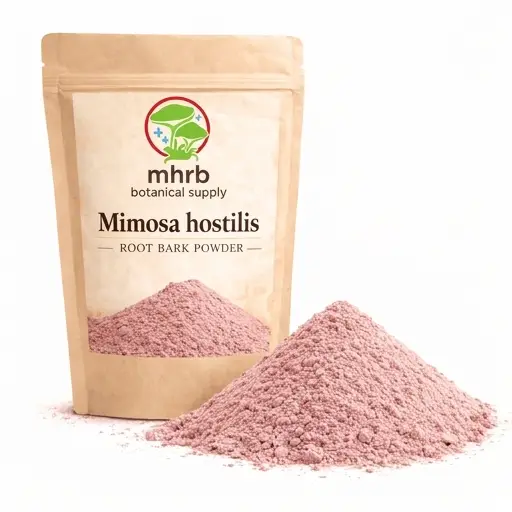
6. Form-Specific Quality Checks
Whole bark — quality checklist:
- Interior cut face shows deep reddish-purple color
- Pieces are firm and fibrous, not brittle or crumbling
- No visible mold, white patches, or dark discoloration
- No musty or unusual smell
- Natural layered structure clearly visible — confirms root bark, not trunk bark
Shredded bark — quality checklist:
- Irregular strips or chips with reddish-purple interior color visible
- No excessive fine dust at the bottom of the bag
- Firm texture — pieces do not crumble when pressed gently
- Consistent color throughout — no pale or grey pieces mixed in
Powder — quality checklist:
- Uniform reddish-brown to purple-brown color throughout
- No hard clumps (if stored correctly)
- Fine, consistent particle size — no grit or coarse material
- Releases rich color immediately when mixed with water
- Earthy, woody aroma present
For a full comparison of all three forms, read: 👉 [MHRB Powder vs Shredded vs Whole: Which Form Is Right for You?]
7. Simple Quality Tests You Can Do at Home
The water test (powder): Add a small pinch of MHRB powder to a glass of water and stir gently. High-quality powder will immediately begin releasing a deep reddish-brown color. Poor-quality or adulterated powder will produce a pale, thin, or inconsistent color release.
The paper test (powder): Press a small amount of damp powder onto white paper and let it dry. Authentic MHRB powder should leave a reddish-brown to purple-brown stain. Natural dyers use this test to gauge dye strength before committing to a full batch.
The fiber test (whole/shredded): Try to separate a small fiber from a piece of whole bark between your fingers. Authentic inner root bark should pull apart in fibrous, thread-like strands. If it crumbles to powder or snaps cleanly like wood, it may be outer bark or trunk bark rather than inner root bark.
Recommended Products
Our MHRB products are ethically sourced, clearly origin-labeled, and quality-checked before shipping:
- 🌿 MHRB Powder — fine-milled, ready to use
- 🌿 MHRB Shredded — versatile, easy to inspect
- 🌿 MHRB Whole — ideal for visual quality assessment
- 🇲🇽 Mexican MHRB (Tepezcohuite)
- 🇧🇷 Brazilian MHRB (Jurema Preta)
Frequently Asked Questions
Q: What color should quality MHRB be? High-quality whole or shredded MHRB should have a deep reddish-purple to burgundy interior. Powder should be a consistent reddish-brown to purple-brown. Pale, grey, or uniformly tan material is a sign of poor quality, over-aging, or incorrect plant part.
Q: How can I tell if MHRB is inner root bark or trunk bark? Inner root bark pulls apart in fibrous strands and has a deep reddish-purple interior. Trunk bark and branch bark tend to be harder, more woody, and significantly lighter in color — often tan or grey-brown rather than purple. Always buy from suppliers who explicitly state “inner root bark” on the product listing.
Q: Is pale MHRB always low quality? Not always — storage conditions can affect color. However, pale color in freshly purchased material is a reliable red flag. If bark is pale and also has little to no smell, it is almost certainly old stock or a different part of the plant than the inner root bark.
Q: Can I test MHRB powder quality at home? Yes. Add a small pinch of powder to water — good powder immediately releases a deep reddish-brown color. You can also press damp powder onto white paper; authentic MHRB leaves a rich reddish-brown stain when dry. These are reliable field indicators used by experienced buyers.
Q: Why does Mexican MHRB look darker than Brazilian? Mexican MHRB (Tepezcohuite) grows in drier, sandier soil with higher resin and fat content, producing deeper purple pigmentation. Brazilian MHRB (Jurema Preta) grows in the semi-arid Caatinga biome and typically shows a lighter reddish-brown to medium purple color. Both are authentic quality MHRB — the difference is a natural result of different growing environments.
Conclusion
Identifying quality Mimosa Hostilis Root Bark comes down to five core checks: color, texture, smell, origin documentation, and supplier transparency. Premium MHRB is deep reddish-purple in color, firm and fibrous in texture, earthy and woody in smell, clearly labeled with its origin and plant part, and sold by a supplier who answers your questions openly. Armed with this knowledge, you can confidently evaluate any MHRB product before and after purchase — avoiding low-quality material and investing only in botanical specimens that meet the standards your work demands.
Compliance Disclaimer
This article is intended for educational and informational purposes only. The information provided does not constitute medical, legal, or professional advice of any kind. Mimosa Hostilis Root Bark is sold strictly as a botanical specimen for research, botanical study, natural dyeing, soap making, and other lawful purposes. It is the sole responsibility of the buyer to understand and comply with all applicable local, state, national, and international laws regarding the purchase, possession, and use of this material. The seller and author make no claims regarding therapeutic, psychoactive, or medicinal properties of this product. This product is not intended to diagnose, treat, cure, or prevent any disease or condition.6. Form-Specific Quality Checks