
Introduction
If you’ve ever looked closely at an Acacia tree and noticed that it seems to have flattened, leaf-like structures instead of traditional leaves, you’ve already encountered phyllodes. The question “what are phyllodes?” comes up frequently among botany students, plant enthusiasts, and researchers who study Australian native plants. Phyllodes are a fascinating example of plant adaptation — a structural solution that allows certain species to thrive in challenging environments where conventional leaves would be a disadvantage. In this guide, we explore what phyllodes are, why they exist, and how they define the appearance and function of Acacia acuminata, one of the most well-studied phyllode-bearing plants in the world. Whether you’re new to botany or deepening your knowledge of Acacia species, this guide covers everything you need to know.
What Are Phyllodes?
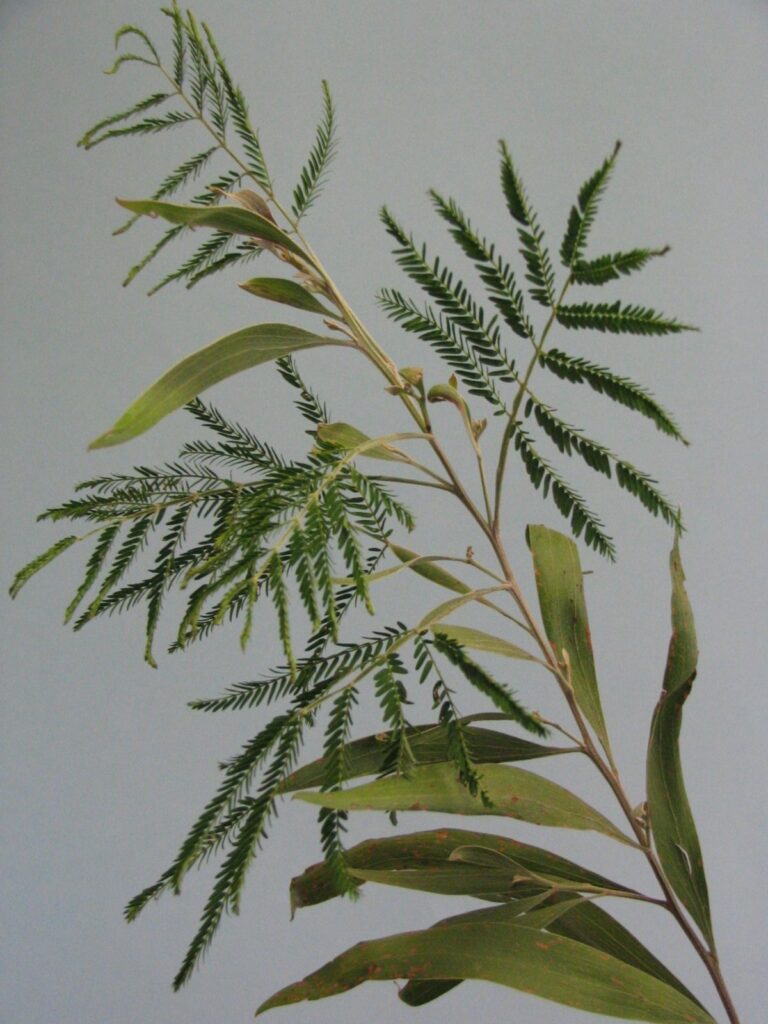
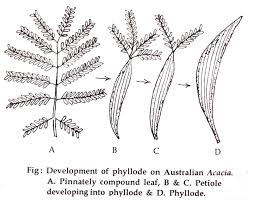
A phyllode is a flattened, leaf-like structure that is not a true leaf at all. Instead, it is a modified petiole — the stalk that normally connects a leaf blade to a stem. In plants that develop phyllodes, the petiole expands, flattens, and takes on the appearance and function of a leaf, while the actual leaf blade either never develops fully or disappears entirely as the plant matures.
Here are the key facts that define phyllodes:
- Phyllodes are technically modified petioles, not true leaves
- They are flat, elongated, and typically green — functioning like leaves by carrying out photosynthesis
- They contain chlorophyll and are fully capable of producing energy for the plant through sunlight
- The leaf blade (lamina) that would normally be attached to the petiole is absent or vestigial in phyllode-bearing plants
- Phyllodes are botanically classified as “phyllodinous” structures when they replace leaves permanently
- They often have a leathery or firm texture compared to conventional leaves
- Many phyllodes are oriented vertically or at an angle, reducing direct sun exposure on the surface — a key adaptation to hot, dry climates
- The term “phyllode” comes from the Greek words phyllon (leaf) and eidos (form or appearance) — literally meaning “leaf-like”
Phyllodes are most commonly associated with the genus Acacia, particularly Australian species. They represent one of the most elegant examples of convergent evolution in the plant kingdom — where the same structural “problem” (efficient gas exchange and photosynthesis in a harsh climate) is solved by repurposing an existing structure rather than evolving an entirely new one.
Why Do Some Plants Develop Phyllodes?
The development of phyllodes is an evolutionary adaptation driven primarily by environmental pressures. Understanding why plants develop phyllodes helps explain why they are so common among Australian Acacia species.
Water conservation
- True leaves with large flat surfaces lose significant water through transpiration
- Phyllodes have a reduced surface area compared to compound leaves and often have a thick, waxy cuticle that slows water loss
- Vertical orientation means less direct sunlight hits the surface, reducing the heat load and further limiting evaporation
Drought resistance
- Many phyllode-bearing Acacia species grow in semi-arid, arid, or seasonally dry regions of Australia
- The leathery texture and reduced surface area allow the plant to survive extended dry periods
- This structural adaptation is a response to environments where rainfall is unpredictable and soil moisture is limited
Reduced herbivory
- Tough, leathery phyllodes are less palatable to many insects and grazing animals than soft, water-rich leaf blades
- Some phyllodes contain tannins and other compounds that further discourage feeding
- The reduced surface area also gives herbivores less plant material to target
Temperature regulation
- The vertical orientation of many phyllodes means they track the sun’s angle throughout the day, reducing peak heat absorption
- This “paraheliotropic” positioning keeps the plant cooler and reduces the risk of photoinhibition (damage from excess light)
Acacia Acuminata and Its Phyllodes
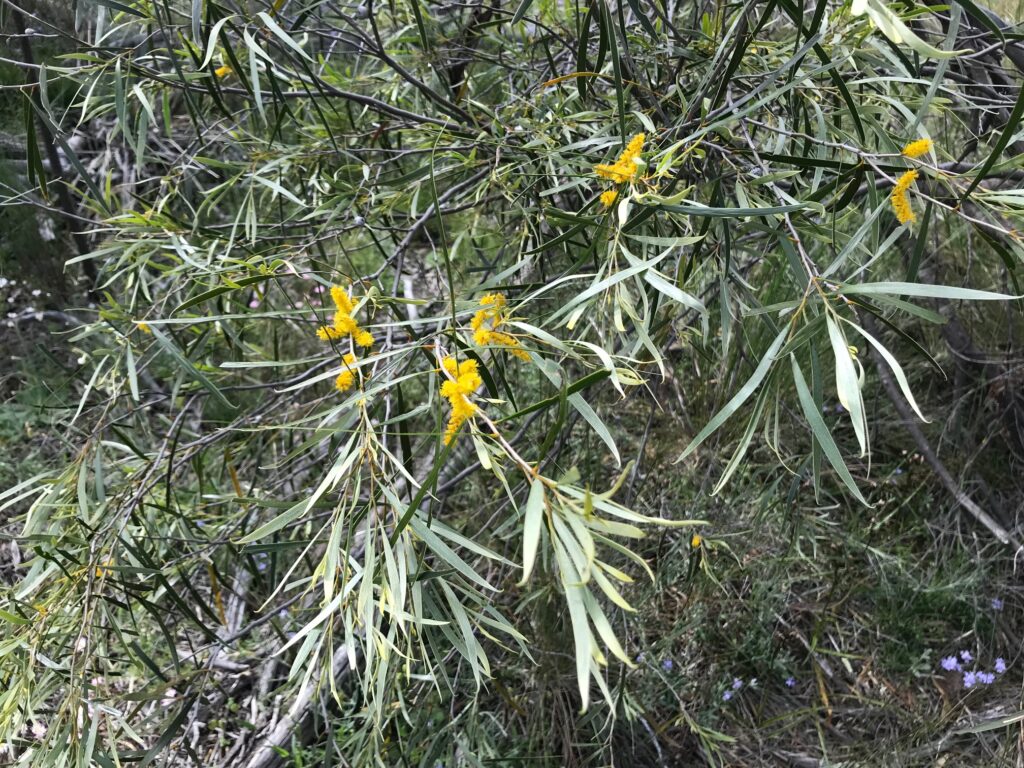
Acacia acuminata, commonly known as Raspberry Jam Wattle or Jam Tree, is a native Australian shrub or small tree that is one of the most recognizable phyllode-bearing plants in the botanical world.
Here is what sets Acacia acuminata apart:
- Native to Western Australia, particularly the wheatbelt and semi-arid inland regions
- Grows as a multi-stemmed shrub or small tree, typically reaching 2 to 5 meters in height
- Named “Raspberry Jam Wattle” because freshly cut wood has a strong raspberry jam-like scent
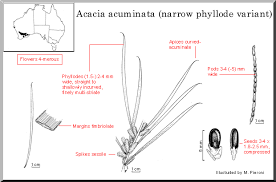
- Produces narrow, elongated phyllodes that are typically 5 to 12 cm long and 2 to 5 mm wide
- Phyllodes are dark green, slightly curved, and come to a sharp tip (the botanical term “acuminata” refers to this sharply pointed tip)
- Produces small, bright yellow spherical flower clusters (typical of the Acacia genus) in late winter to spring
- Adapted to survive in sandy, gravelly, or loamy soils with low fertility and low rainfall
- Well-studied in ethnobotanical research and botanical chemistry due to its phytochemical profile
- The phyllodes and bark are the most frequently studied parts of the plant in academic literature
Key Characteristics of Acacia Acuminata Phyllodes
- Shape: Narrow and linear to slightly falcate (curved like a sickle)
- Length: Typically 5–12 cm
- Width: 2–5 mm — very narrow compared to many other Acacia species
- Color: Deep green to grey-green on both surfaces
- Texture: Firm, leathery, smooth
- Tip: Sharply pointed (acuminate)
- Venation: 3–5 longitudinal veins running the length of the phyllode
- Orientation: Often held at an angle or vertically to reduce direct sun exposure
- Surface coating: Thin waxy cuticle to reduce water loss
- Arrangement: Alternate along the stem, not opposite or whorled
Phyllodes vs True Leaves: Key Differences
Understanding how phyllodes differ from conventional leaves clarifies why they represent such a distinctive botanical structure:
Structure
- True leaf: consists of a blade (lamina) + petiole (stalk)
- Phyllode: the petiole itself is flattened and expanded — the blade is absent or non-functional
Origin
- True leaf: develops from the leaf primordium in its entirety
- Phyllode: develops from the petiole, which undergoes morphological modification
Surface area
- True leaf: typically broad and flat, maximizing light capture
- Phyllode: narrow and elongated, reducing surface area to limit water loss
Texture
- True leaf: often soft, thin, and pliable with visible veination
- Phyllode: firm, leathery, and often waxy with parallel venation
Orientation
- True leaf: typically horizontal to maximize sun exposure
- Phyllode: often vertical or angled to reduce sun exposure and heat load
Function in dry climates
- True leaf: less efficient in arid conditions — high water loss through transpiration
- Phyllode: highly efficient in dry climates — low water loss, high drought tolerance
Found in
- True leaves: the vast majority of plant species globally
- Phyllodes: primarily Acacia (wattle) species, and a small number of other genera including some orchids and aquatic plants
Importance in Botanical Study
Phyllodes, and Acacia acuminata in particular, are significant in several fields of plant science:
Evolutionary biology
- Phyllodes offer a clear, observable example of convergent evolution and morphological plasticity — the ability of a structure to change form in response to environmental pressure
- Young Acacia seedlings often produce true compound leaves before transitioning to phyllodes as they mature — this developmental sequence is studied to understand evolutionary transitions
Ethnobotany
- Acacia acuminata has a well-documented history of use by Aboriginal Australian communities
- The plant is recognized in Australian ethnobotanical literature for its cultural and practical significance
Phytochemistry
- The phyllodes and bark of Acacia acuminata contain a documented phytochemical profile including alkaloids, tannins, and flavonoids
- Academic studies have analyzed the chemistry of various Acacia species, including acuminata, as part of broader research into Australian native plant compounds
Taxonomy and identification
- Phyllode shape, size, tip form, and venation pattern are primary diagnostic features used to identify and classify Acacia species in the field
- Correct identification of phyllode characteristics is essential for botanical survey work
Recommended Products
Explore our range of ethically sourced Acacia acuminata botanical products:
- Acacia Acuminata Phyllodes — dried, whole phyllodes for research and botanical study
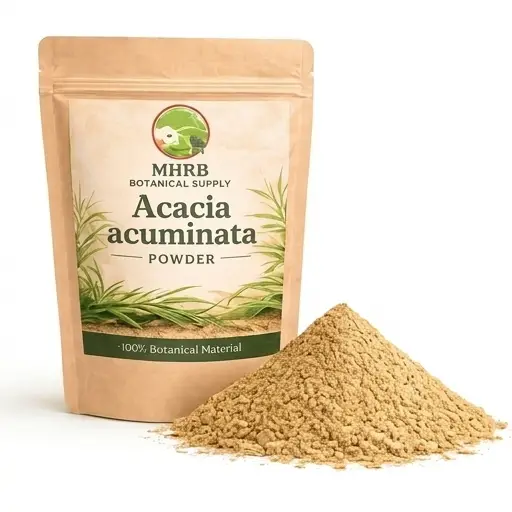
- Acacia Acuminata Powder — finely milled phyllode powder
- Browse All Acacia Products — full range of sustainably sourced Acacia species
All products are sourced responsibly from ethical suppliers, tested for quality, and packaged to preserve botanical integrity.
Storage and Handling
Proper storage of Acacia acuminata phyllodes ensures the material retains its botanical quality for as long as possible.
Whole dried phyllodes
- Store in a sealed, airtight container — a glass jar or vacuum-sealed bag works best
- Keep in a cool, dark location away from direct sunlight and humidity
- Avoid storing near heat sources such as radiators or ovens
- Shelf life: 18–36 months under proper conditions
- Do not compress or crush whole phyllodes during storage — this damages the cellular structure
Powdered phyllodes
- Store in an airtight glass jar with a silica gel packet to absorb moisture
- Powder is more susceptible to clumping, oxidation, and moisture damage than whole material
- Avoid frequent opening of the container — each opening exposes the powder to air and humidity
- Shelf life: 12–18 months under optimal conditions
General handling tips
- Always use clean, dry tools when handling botanical material
- Avoid direct skin contact with fine powder — use gloves and a dust mask when measuring or transferring
- Label containers with the batch date and origin for accurate stock rotation
- If you detect any musty or unusual odor, the material may have been exposed to moisture and should not be used
Frequently Asked Questions
1. What are phyllodes in simple terms? Phyllodes are flattened, leaf-like structures that are actually modified leaf stalks (petioles), not true leaves. They perform photosynthesis just like leaves but are structurally different. They are most commonly found in Acacia (wattle) trees and are an adaptation to survive in dry, hot climates.
2. Are phyllodes the same as leaves? No. While phyllodes look like leaves and function similarly, they originate from a different part of the plant. A true leaf has both a blade and a stalk. A phyllode is an expanded, flattened version of just the stalk — the leaf blade is absent. Botanically, they are distinct structures.
3. Why does Acacia acuminata have phyllodes instead of leaves? Acacia acuminata evolved in the semi-arid regions of Western Australia where water is scarce. Phyllodes are far more efficient in dry climates because they lose less water than broad leaves, resist heat better, and are tougher against grazing. They are an evolutionary adaptation to survive in a challenging environment.
4. Can you identify an Acacia species by its phyllodes? Yes. Phyllode shape, size, color, width, tip type, and venation pattern are the primary features used by botanists to identify Acacia species. Acacia acuminata is identified by its narrow, sharply pointed phyllodes with 3–5 parallel veins — characteristics that are distinct from other Acacia species.
5. Is Acacia acuminata legal to buy and own? In most countries, Acacia acuminata is sold legally as a botanical specimen for research, study, and collection. However, regulations vary by country and region. It is always the buyer’s responsibility to verify local laws regarding the purchase and possession of this material before ordering.
Conclusion
Phyllodes are one of nature’s most elegant structural solutions — a repurposed leaf stalk that evolves into a fully functional photosynthetic organ adapted to harsh environments. Understanding what phyllodes are, and why plants like Acacia acuminata developed them, opens a window into the remarkable adaptability of the plant kingdom. From water conservation and drought resistance to herbivory reduction and temperature regulation, phyllodes serve multiple survival functions simultaneously. For botanists, researchers, and natural product enthusiasts alike, Acacia acuminata and its distinctive narrow phyllodes represent one of Australia’s most fascinating native plant species. Whether you’re studying plant morphology, exploring ethnobotany, or sourcing quality botanical material, this guide gives you the foundation to engage with this topic confidently.
Compliance Disclaimer
This article is intended for educational and informational purposes only. The information provided does not constitute medical, legal, or professional advice of any kind. Acacia acuminata phyllodes are sold strictly as botanical specimens for research, botanical study, and other lawful purposes. It is the sole responsibility of the buyer to understand and comply with all applicable local, state, national, and international laws regarding the purchase, possession, and use of this material. The seller and author make no claims regarding therapeutic, psychoactive, or medicinal properties of this product. This product is not intended to diagnose, treat, cure, or prevent any disease or condition.